
Looking for a PC case you can game or work next to without the fan whine? A silent PC case is built around slow-spinning fans, sound-damped panels, and unobstructed airflow — so components stay cool without screaming. This guide covers what silent actually means in decibels, which features matter, and which XERON cases deliver near-zero noise.
Quick Answer: Silent PC Case dB Levels
| Environment | Typical Noise | What It Feels Like |
|---|---|---|
| Library / whisper | 25-30 dB | You have to lean in to hear it |
| Quiet office | 35-40 dB | Background hum, easy to ignore |
| A good silent PC | 28-35 dB | Inaudible during normal use |
| Average gaming PC | 45-55 dB | Fan whine noticeable under load |
| Loud / cramped case | 60+ dB | Hurts to sit next to |
Building to under 35 dB is realistic with the right case and a conservative fan curve. You do not need an anechoic chamber — you need airflow that lets fans run slow.
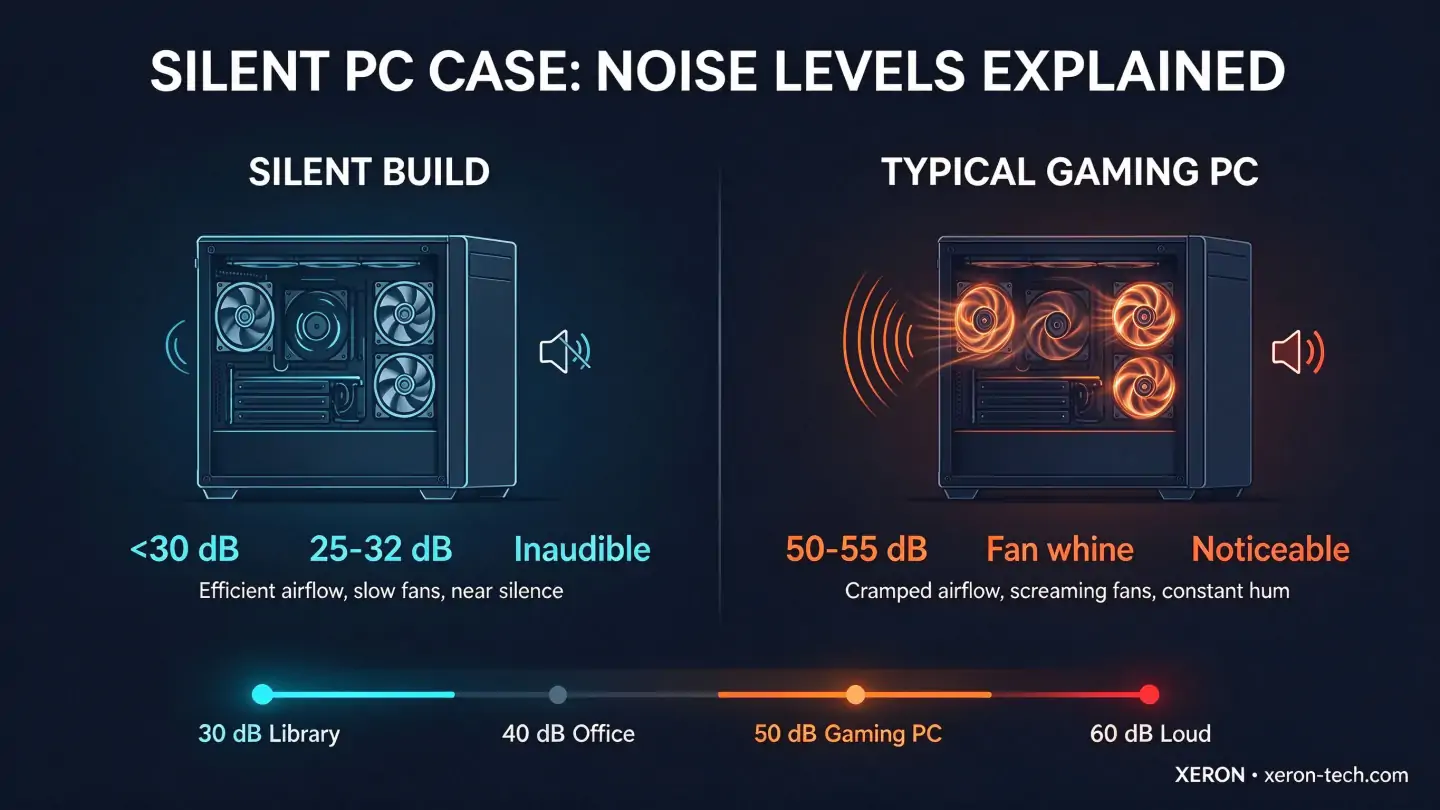
What Makes a PC Case Silent?
Three things separate a silent case from a regular one:
| Feature | Why It Matters |
|---|---|
| Large 140mm fan mounts | A 140mm fan moves as much air as a 120mm fan at 40% lower RPM, and lower RPM means far less whine |
| Straight airflow path | Intake to exhaust with no sharp bends means fans push less hard — static pressure is the enemy of silence |
| Damped / rigid panels | Thick steel or sound-damped foam stops side-panel resonance that makes cheap cases rattle |
The common mistake is buying a case with solid panels and foam everywhere. That blocks airflow, fans spin faster, and the PC gets louder. The best silent cases move air efficiently so fans never have to race.
Silent vs Quiet PC Case: What Is the Difference?
People use the words interchangeably, but there is a practical split:
Quiet case = a regular case with slow fans and good airflow. You will hear it under load, but it is not annoying. Most mid-towers with mesh front panels fall here.
Silent case = engineered for near-inaudible operation. Damped panels, a separate PSU chamber so the PSU fan never spins up, and fan mounts sized for large slow 140mm or 180mm fans. These target under 35 dB at full load.
If you game next to your PC or put it in a living room, aim for silent. If it sits under a desk in a separate room, quiet is enough.
3 Upgrades That Make the Biggest Noise Difference
| Upgrade | Typical Noise Drop | Why It Works |
|---|---|---|
| 1. Set a 40-60% fan curve | -8 to -15 dB | Most BIOSes run fans at 100% by default; 40% is enough for idle and light loads |
| 2. Swap 120mm fans for 140mm | -5 to -10 dB | Bigger blades move more air per revolution |
| 3. Pick a case with a separate PSU channel | -3 to -6 dB | The PSU gets its own cool air and its fan stays off until heavy load |
These three changes usually take a system from 50 dB to under 35 dB without spending money on expensive foam-lined cases.
Best Silent PC Cases from XERON
XERON does not line cases with foam. The brand takes the airflow route to silence — cool components, slow fans, no resonance. Three models fit a silent build:
| Model | Why It Works for Silence | Best For |
|---|---|---|
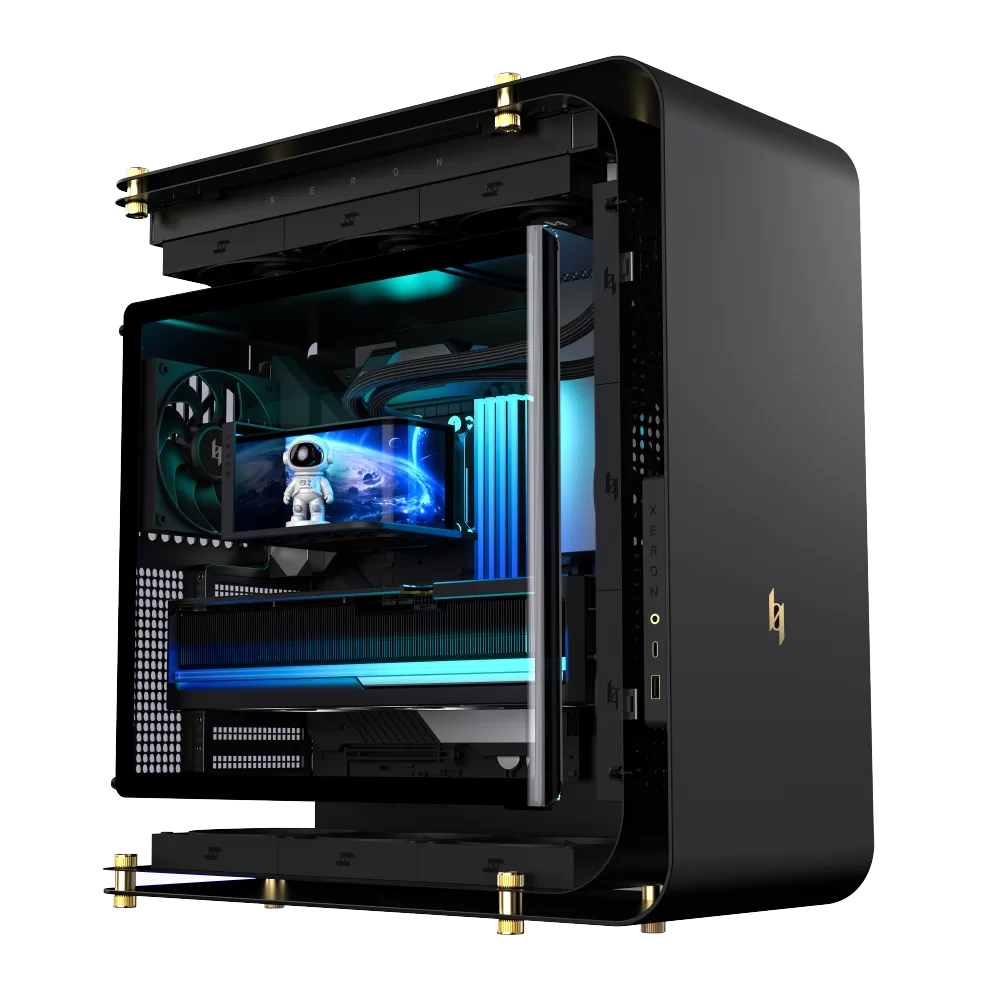 NEX C Lab | Independent intake channels for CPU, GPU and PSU — each component gets fresh air, fans stay slow | High-end silent builds, flagship GPUs |
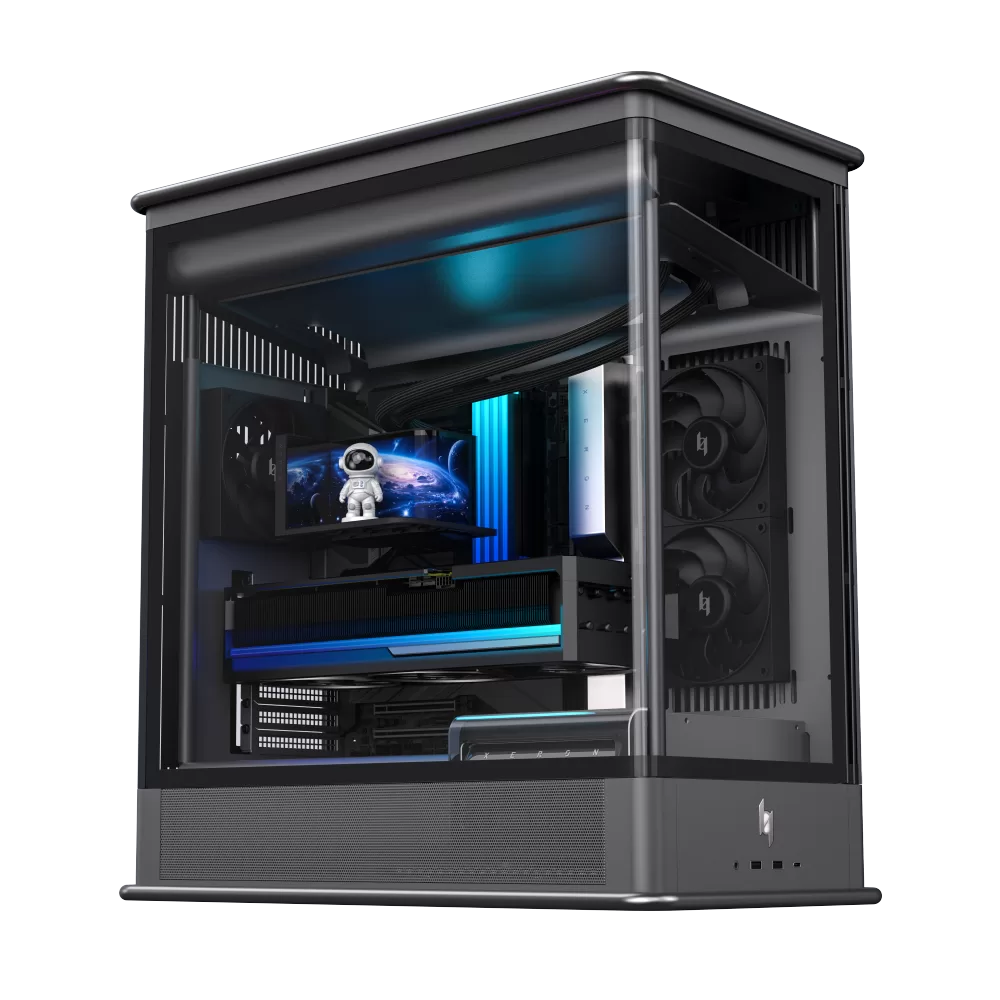 NEX S Lab | Open frame or louvered shell options, top full-opening design, zero airflow obstruction | Enthusiasts who want maximum cooling with minimal fan speed |
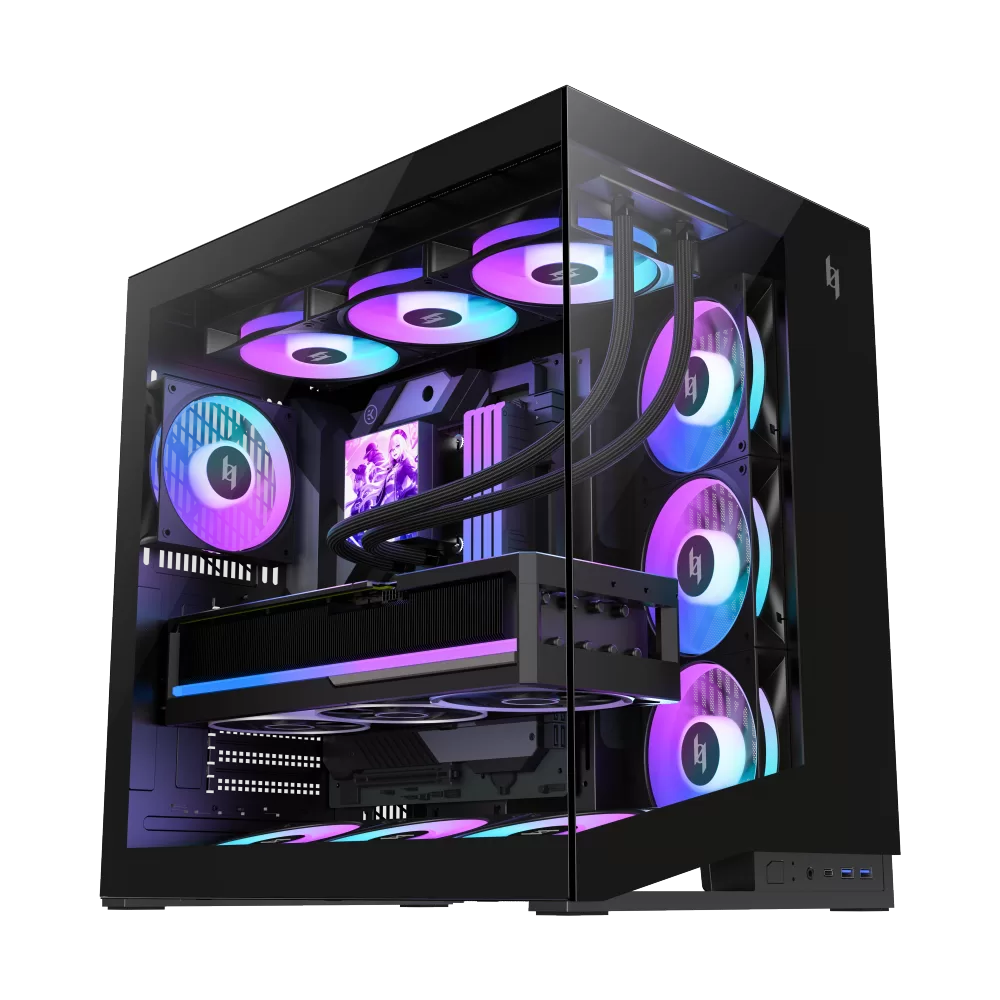 NEX C56 | 3x 120mm bottom intake, 3x 120mm motherboard side, rear exhaust, supports 360mm top AIO | Value silent builds, standard ATX gaming rigs |
Silent PC Case — FAQ
| Question | Answer |
|---|---|
| What dB is a silent PC? | Under 35 dB at full load. A library is 30 dB, so a well-built silent PC is inaudible during browsing, streaming, and most gaming. Under heavy rendering it may climb to 35-40 dB. |
| Are silent cases worth it? | If your PC is on your desk or in your living room, yes. The difference between 50 dB and 30 dB is night and day for focus and comfort. If it sits in a closet, a regular case is fine. |
| Do foam-lined cases actually work? | They damp panel rattle, but they also block airflow which forces fans to spin faster. The net noise result is often worse. Efficient airflow beats foam. |
| Is water cooling quieter than air? | A 360mm AIO with three slow fans is often quieter than a small air cooler under load. What matters is radiator size, not the liquid itself. |
| Can I make my current PC silent? | Yes. Set a fan curve (40% idle, 60% at 60 C), clean the dust filters, replace small fans with 140mm where possible, and make sure the PSU has its own cool intake. Most systems drop 10+ dB from these steps alone. |
| What PSU is best for a silent build? | A PSU with a hybrid fan mode that keeps the fan off under low load. If the case has a separate PSU chamber, the PSU fan stays off longer. |
| Do silent cases affect gaming performance? | No. Good airflow means lower component temperatures, which can actually boost sustained performance. Silence and thermals go hand in hand. |
| Is a silent PC good for streaming? | Absolutely. Streamers want their mic to pick up game audio and voice, not fan noise. A silent case removes the constant background hum from recordings. |
Related Noise & Cooling Guides
| Topic | Read Next |
|---|---|
| How to build a quiet rig from scratch | Quiet PC Case: Build a Silent Rig |
| PSU sizing for silent systems | PSU Calculator |
| Check for CPU bottlenecks | Bottleneck Calculator |
| Shop cases built for airflow | Explore XERON Cases |
Ready for a silent desk or living room? XERON cases are designed around straight airflow and slow fans — no foam, no rattle, no screaming. Browse the XERON lineup →